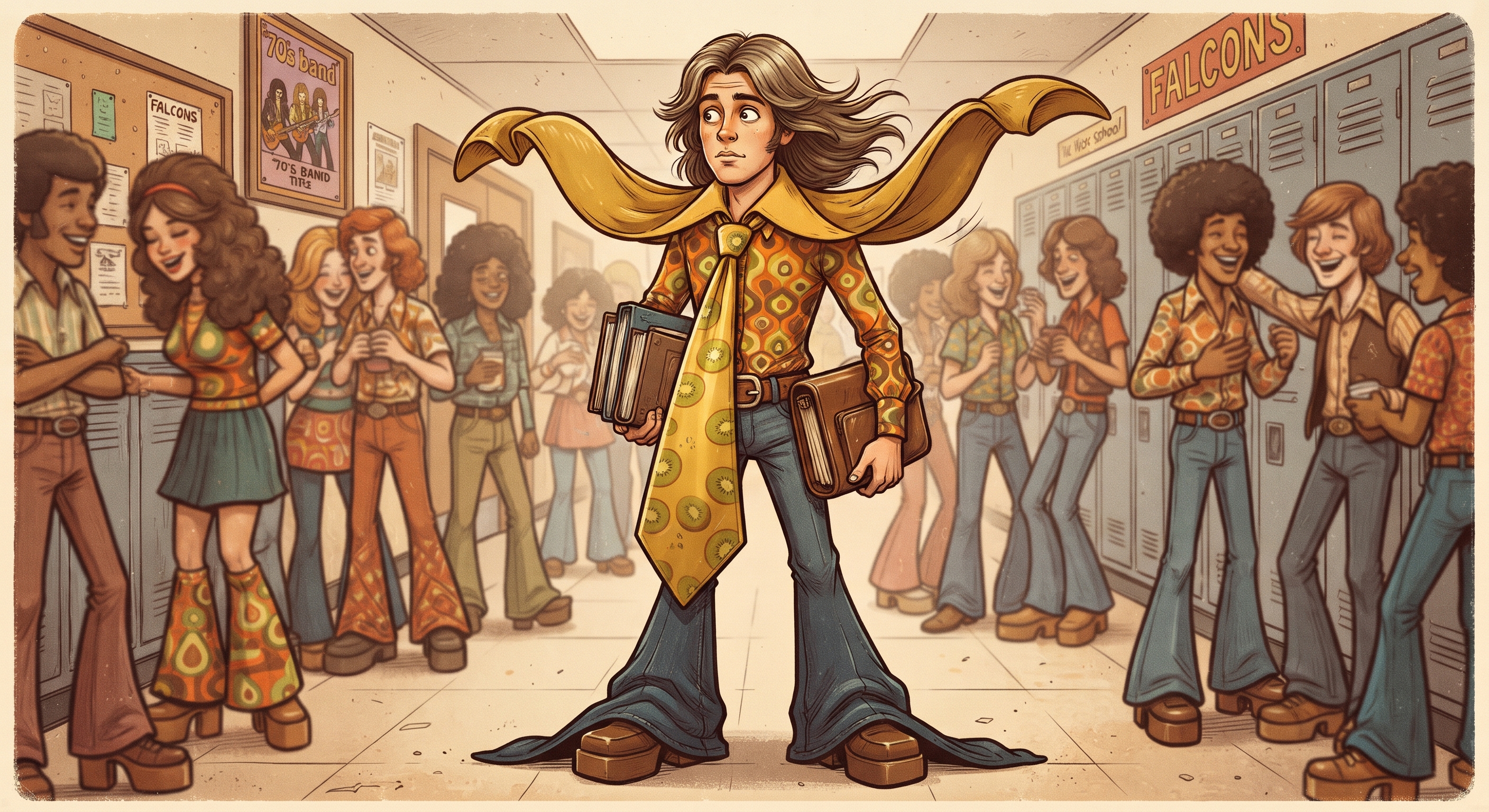

If you survived 1970s teenage life, you didn’t just survive awkward crushes and rotary phone panic—you walked out of high school looking like a walking health and safety hazard.
Teenage fashion logic in the ’70s dictated that comfort, practicality, and basic human dignity were completely secondary to looking “cool.” This usually meant wearing clothes made from materials that could double as industrial insulation, and hair products that defied the laws of physics.
Take a nostalgic, tear-eyed look back at the absolute worst 1970s fashion and hair trends that teenagers willingly endured just to catch their crush’s eye:
1. The Highly Flammable Polyester Shirt
Before natural breathable fabrics were standard, the ’70s gifted the world with 100% pure, unadulterated polyester.
- The Crime: These shirts came in blinding, psychedelic geometric prints that looked like a optical illusion had exploded across your chest. They didn’t breathe; instead, they trapped your body heat like a baked potato in foil.
- The Danger: Standing too close to a school radiator or a birthday candle meant you were one spark away from bursting into flames.
2. Massive Bell-Bottoms That Doubled as Brooms
Pants in the ’70s started tight at the thigh and flared out at the bottom with the enthusiasm of a ship’s sail.
- The Crime: The hems of these pants were so wide they dragged at least three inches on the floor, absorbing rainwater, mud, sidewalk salt, and stray gravel.
- The Result: By the end of a rainy school day, you were essentially wearing two heavy concrete blocks on your ankles, leaving a muddy trail straight down the hallway.
3. The Dreaded Middle Part and “Dippity-Do” Helmet Hair
For guys, hair was supposed to be long, flowing, and perfectly parted right down the middle—think young pop stars or football players.
- The Crime: Achieving this required heavy-duty styling gels like Dippity-Do or massive amounts of hairspray.
- The Result: On a windy day, your middle part would split open like a theater curtain, exposing your forehead. And if you got caught in a light drizzle, the gel would melt, gluing your hair to your face like wet spaghetti.

4. Platform Shoes (With Zero Ankle Support)
Why be a normal height when you could stand four inches taller on a hunk of stacked wood and chunky rubber?
- The Crime: Both boys and girls wore platform shoes that made walking look like a tightrope-walking exercise gone wrong.
- The Danger: Trying to sprint down the high school hallway when the bell rang while wearing three-inch wooden wedges was an extreme sport. One misstep on a linoleum floor meant an instant, highly public ankle sprain.
5. The “Feathered” Haircut (Farrah Fawcett Wings)
For girls, the ultimate goal was the iconic feathered haircut—a massive, wind-swept mane that required industrial-strength hairspraying to hold its shape.
- The Crime: This hairstyle required a daily battle against gravity. You had to flip, curl, and spray your hair until it had the aerodynamic wingspan of a small aircraft.
- The Hazard: If anyone hugged you too tightly, your hair would permanently snap off or crunch like dry autumn leaves because of all the lacquer holding it together.
6. The Wide Kiwi Tie and Extra-Large Collars
Even school dress codes couldn’t save boys from the tyranny of the oversized collar.
- The Crime: Shirt collars were so long and floppy they rested on your shoulders, flapping around like bat wings whenever you turned your head. Pair that with a giant, spatula-sized “kiwi” tie in hideous shades of mustard yellow or avocado green, and you looked like a cartoon car salesman.
The Takeaway
Looking back at old photo albums from the 1970s is a humbling experience. We walked around smelling of cheap cologne, wearing highly flammable plastic shirts, dragging three pounds of mud on our bell-bottoms, and wondering why our crush didn’t wave back.
We looked ridiculous—but by golly, we looked confident while doing it!






Leave a Reply