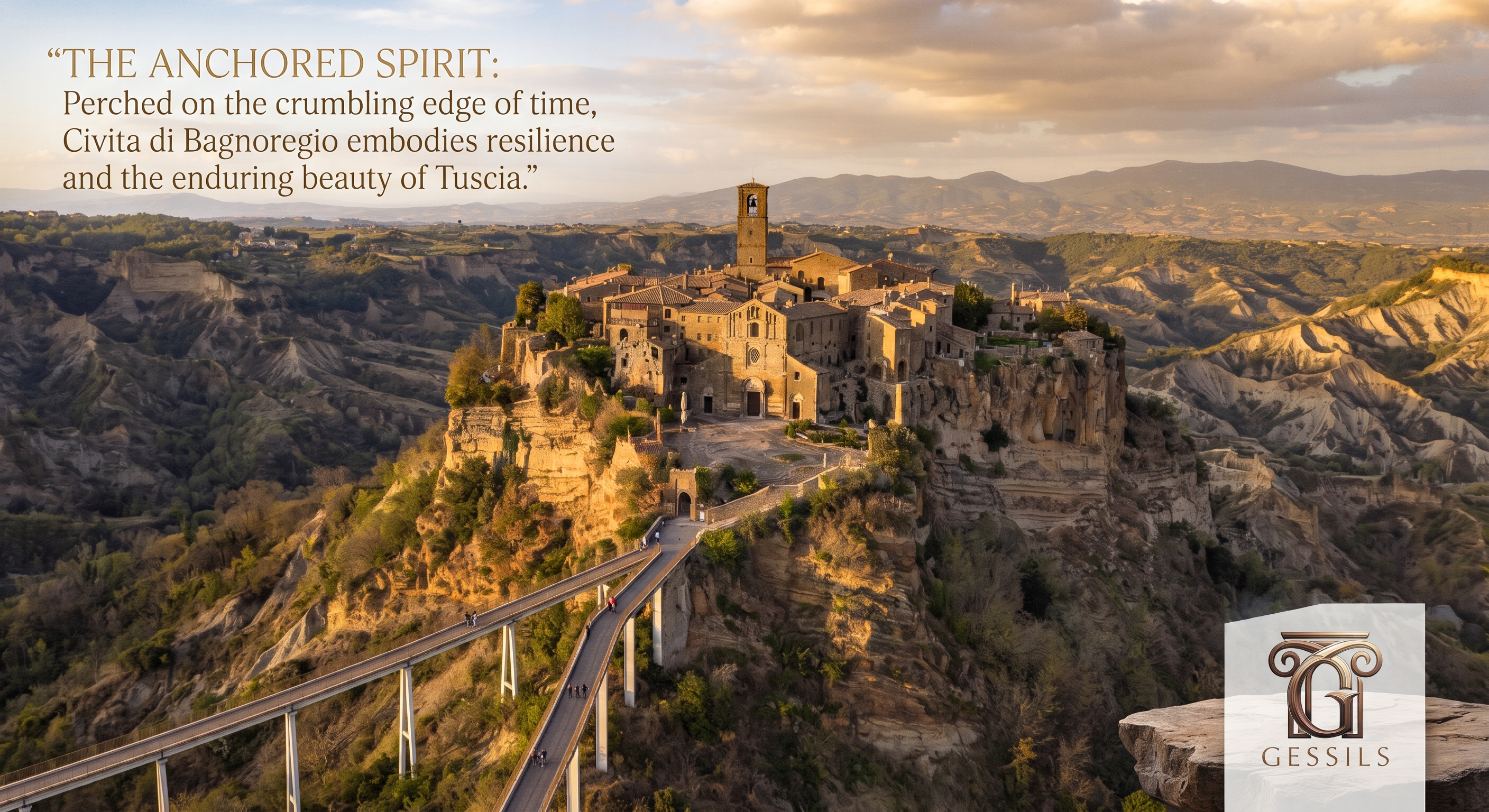
Perched atop a crumbling plateau of friable volcanic tuff in central Italy, Civita di Bagnoregio famously bears the moniker “la città che muore”—the dying city. Surrounded by sweeping badlands (calanchi) that steadily erode under wind and rain, the village feels suspended between earth and sky. At the pulsating heart of this isolated borgo lies the Church of San Donato (Chiesa di San Donato). Facing the old communal palace in the main dirt-packed square, San Donato is far more than a local parish church; it is a monumental testament to architectural layering, multi-centennial survival, and the deep historical roots of the Tuscia region.

Architectural Stratigraphy: From Etruscan Roots to Renaissance Facades
The biography of San Donato is written directly into its stones, reflecting a timeline that spans millennia. The site upon which the church rests carries a history far older than the building itself, tracing back to the Etruscans who originally founded Civita in the 6th century BC.
The architectural evolution of the church is a palimpsest:
- The Ancient and Romanesque Core: Local tradition traces the earliest Christian iteration of the structure to the 5th or 6th century, likely erected over the remnants of an ancient Roman structure or temple. Beneath subsequent modifications, fundamental elements of an 11th- and 12th-century Romanesque layout remain.
- The Bell Tower and Etruscan Spolia: One of San Donato’s most striking features is its bell tower. Embedded directly into its masonry at the base are two genuine Etruscan sarcophagi carved from nenfro (a local dark volcanic stone). This direct reuse of ancient pagan burial artifacts into sacred Christian architecture encapsulates the historical continuity of the cliff—where past civilizations literally prop up the present.
- Renaissance Interventions: In 1511, major structural changes altered the east end of the church. Designed by architect Nicola Matteucci of Caprarola, the eastern wall, old crypt, and original high altar were demolished to make way for a revised presbytery and choir. Decades later, the facade received a Renaissance makeover, featuring a central portal completed in 1524 and flanked by two side portals added in 1547.

From Cathedral to Parish: The Cataclysm of 1695
For centuries, San Donato held immense ecclesiastical weight. From around the year 600 onward, it served as the official cathedral and the seat of the Diocese of Bagnoregio, anchoring a thriving community of faith, governance, and commerce.
However, the precarious geological nature of Civita ultimately reshaped the church’s destiny. On June 11, 1695, a catastrophic earthquake struck the region. The tremor heavily damaged the cathedral and large portions of the surrounding town center, accelerating the steady isolation of the plateau. Recognizing the structural vulnerability of the site, Pope Innocent XII issued the papal brief Super Universas on February 20, 1699, transferring the diocesan seat away from Civita to the neighboring town of Bagnoregio (into the collegiate church of San Nicola). Stripped of its cathedral status, San Donato was demoted to a parish church, mirroring the slow depopulation of the eroding city around it.
Sacred Treasures Within
Stepping across the threshold of San Donato is akin to entering a quiet treasure chest. Despite the turbulent history and structural shifts, the interior preserves remarkable works of sacred art:
- The Miraculous 15th-Century Crucifix: The undisputed spiritual centerpiece of the church is a venerated wooden crucifix carved by an artist from the school of Donatello. Beyond its artistic mastery—noted for how the perspective of Christ shifts depending on the viewer’s angle (appearing alive from the front, dying from the left, and deceased from the right)—the crucifix is steeped in local lore. Legend holds that during a devastating plague in 1499, the figure miraculously spoke to a pious local woman, assuring her that the pestilence would soon end. Today, the crucifix remains deeply revered and is carried through the streets during the solemn Good Friday procession.
- Renaissance Frescoes: The interior also houses delicate artistic remnants, including fragments of frescoes attributed to the workshop of Pietro Perugino, linking the remote cliffside church to the broader artistic masters of the Umbrian-Roman Renaissance.

Conclusion
The Church of San Donato stands as a powerful metaphor for Civita di Bagnoregio as a whole. Buffeted by shifting earth, severe earthquakes, and the relentless forces of erosion, the building has continually adapted, shedding parts of its past while stubbornly holding onto others. Encapsulating Etruscan stone, Romanesque walls, Renaissance symmetry, and enduring folk devotion, San Donato remains a silent sentinel—watching over a vanishing landscape with steadfast, timeless grace.

Leave a Reply