
Threads of Steel and Asphalt: The New Transit Horizon in Scarborough
For decades, the transit story of Scarborough was one of resilience written against the backdrop of growing pains. When the aging legacy of Line 3—the Scarborough RT—came to its historic close, it left behind a quiet grief among daily commuters and a profound structural void. For a community built on motion and connection, the loss of direct rapid transit felt like a severing of ties to the wider heart of Toronto.
Yet, out of that transition, a grander vision has taken root. Today, Scarborough stands at the threshold of a modern transit renaissance—one driven by adaptive engineering, heavy infrastructure, and an unwavering commitment to equity in motion.
Bridging the Gap: The Triumph of the Scarborough Busway
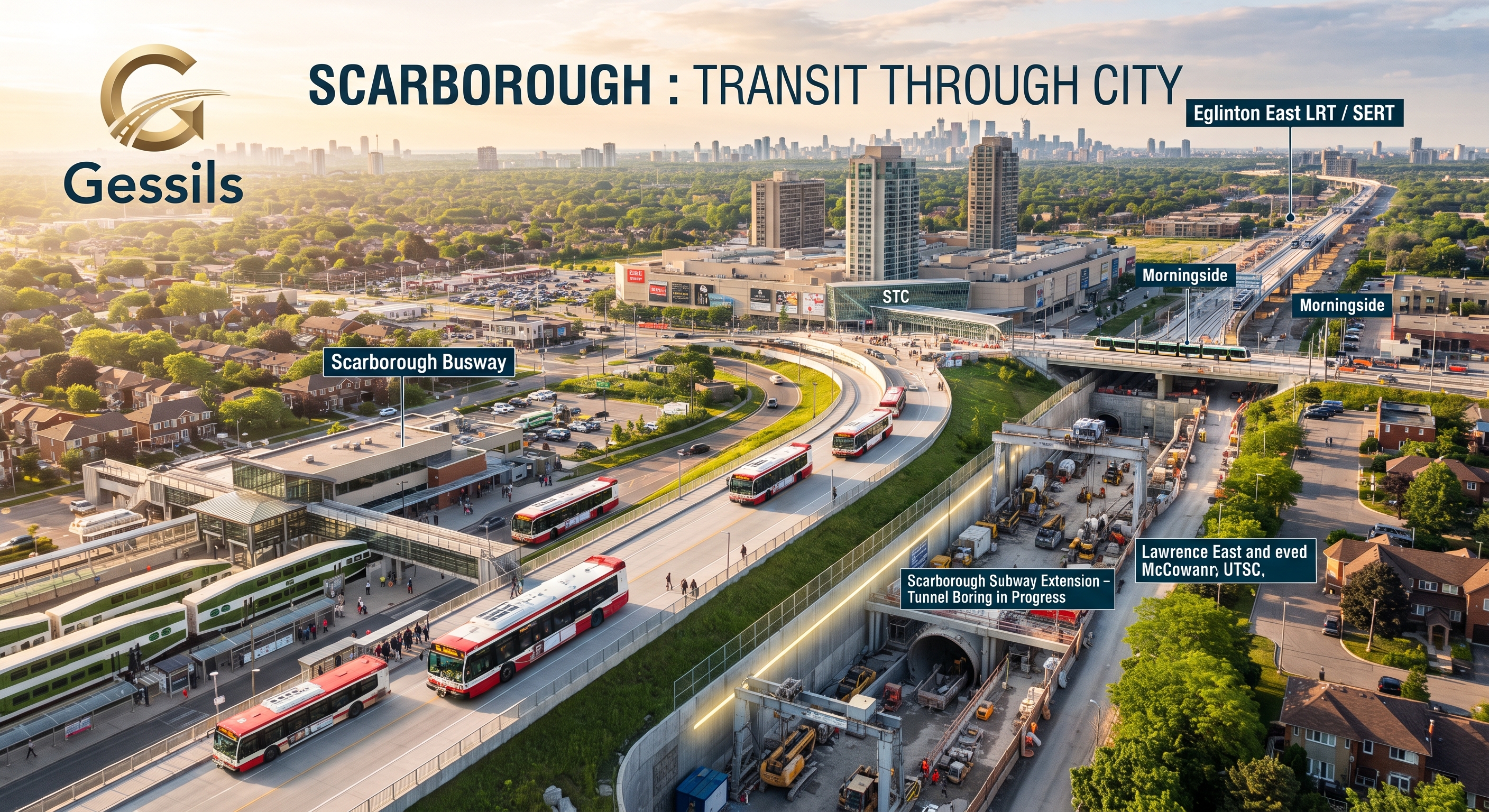
The immediate aftermath of Line 3’s closure demanded ingenuity, and the answer arrived in the form of the Scarborough Busway. Transforming the old 4-kilometre rail right-of-way into a dedicated transit-only pathway between Kennedy Station and Ellesmere—and flowing seamlessly up to Scarborough Town Centre via priority lanes—changed the daily rhythm of the east end.
Opening its lanes to service, this dedicated corridor restored precious time to tens of thousands of weekly riders. It proved that progress does not always have to wait for the distant horizon; sometimes, it is forged by reclaiming what is already there and reshaping it to serve the community better. Dropping commute times between major hubs down to a brisk 15 minutes, the Busway became a testament to local determination.

Deep Roots: The Scarborough Subway Extension
Looking further ahead, the bedrock of Scarborough’s long-term future is taking shape deep beneath its surface. The Scarborough Subway Extension (SSE) represents one of the most ambitious civil engineering feats in the region’s history. With tunneling past its halfway mark and station construction surging forward at sites like Scarborough Centre, the 7.8-kilometre underground route is steadily turning a long-held promise into reality.
By extending the Bloor-Danforth Line 2 straight into the heart of Scarborough—with new stops at Lawrence-McCowan, Scarborough Centre, and a terminal at Sheppard-McCowan—the project heals the old fragmentation of the commute. No longer will residents face cumbersome transfers just to move across the city; the subway will knit Scarborough directly into the continuous grid of downtown Toronto, carrying tens of thousands of new daily riders into a future of effortless mobility.
Weaving the Network: The Eglinton East LRT
Complementing these veins of steel and concrete is the horizon of the Scarborough East Rapid Transit (Eglinton East LRT) initiative. Designed to cast a wider net across historically underserved neighborhoods, this planned rapid transit line promises to interlock the eastern reaches of the city [cite:. It will stitch together local community hubs, commercial districts, and rapid transit spines, ensuring that no neighborhood is left stranded on the periphery of the network.
A Unified Tomorrow
Transit is never merely about getting from point A to point B; it is about human connection. It is about the student reaching an early morning class, the artist finding inspiration across town, and families visiting loved ones without the penalty of distance.
Through the resourceful ingenuity of the Busway and the transformative scale of the Subway Extension, Scarborough is reclaiming its momentum. The lines are being drawn, the tunnels are being carved, and a revitalized east end is stepping boldly into its next chapter—connected, accessible, and moving forward as one.





Leave a Reply