
The Architecture of Astonishment: Finding Grace in the Midst of Things
When the Swedish Academy awarded the 2026 Nobel Prize in Literature to Canadian poet and classicist Anne Carson, it honored an oeuvre defined by a bold and inventive refusal of rigid boundaries. Carson’s writing—spanning verse, translation, essay, and visual art—teaches us that literature is not a static monument, but a living, breathing act of inquiry. It asks us to look at the ancient and the everyday through a single, luminous lens.
That rare capacity to blend intellectual rigor with stark, emotional precision is brilliantly captured in her short poem, O Small Sad Ecstasy of Love.
The Roadside Epiphany
I like being with you all night with closed eyes.
What luck—here you are coming along the stars!
I did a road trip all over my mind and heart
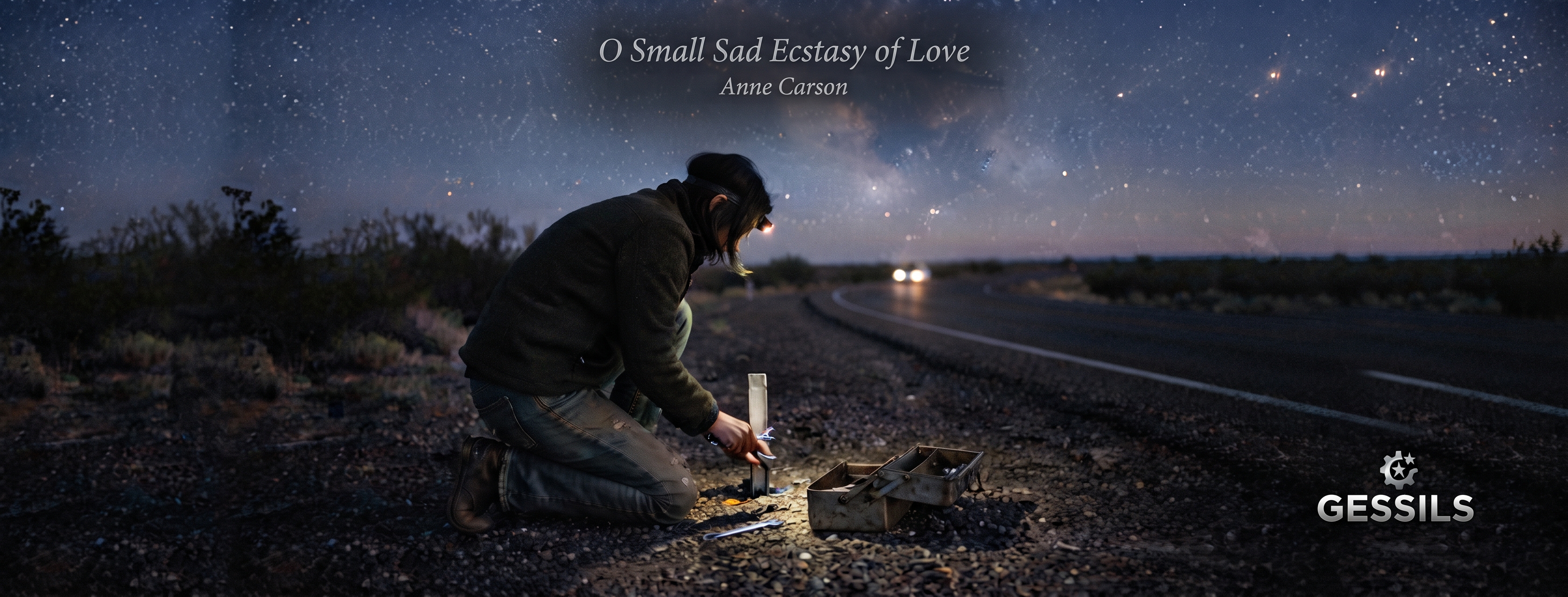
and there you were, kneeling by the roadside
with your little toolkit, fixing something.
Give me a world, you have taken the world I was.
At first glance, the poem operates in a register of quiet domestic intimacy, yet it quickly stretches out into the cosmic. Carson juxtaposes the vulnerability of closed eyes with the dizzying scale of the stars. The speaker’s internal journey—a “road trip all over my mind and heart”—is a universal metaphor for emotional exhaustion, the quiet wear and tear of navigating one’s own internal landscape.
And then comes the profound pivot: finding someone kneeling by the roadside with your little toolkit, fixing something.
A Nobel Perspective on Human Vulnerability
In honoring Carson, the Nobel Committee celebrated a writer who investigates the friction of desire, loss, and human connection. O Small Sad Ecstasy of Love embodies this exact genius. Love, in Carson’s hands, is not an abstract ideal or a grand, cinematic explosion. It is practical, humble, and tenderly ordinary. It is a partner acting as a mechanic for a broken spirit, carrying a “little toolkit” to mend the invisible machinery of our minds.
There is an inherent inspiration in this imagery. We live in an era that endlessly tells us to fix ourselves, to optimize our minds, and to travel our internal highways alone. Carson’s poem gently disrupts that isolation. It suggests that true grace arrives when someone else meets us in our breakdown—not to judge the wreckage of our road trip, but to quietly start repairing it under the vast, indifferent beauty of the stars.
The World Transformed
The poem concludes with a striking emotional paradox: “Give me a world, you have taken the world I was.”
This is the ultimate signature of a master poet. To be loved—and to truly inhabit art of the highest caliber, such as Carson’s Nobel-winning body of work—is to have your old, narrow self dismantled so that a wider, more honest world can take its place. It reminds us that transformation often begins right where we stall out: in the dark, on the side of the road, waiting for a little light.





Leave a Reply